About this MVP
Seeded with multi-tenant architecture content, variants, reviews, stack metadata, and platform-hosted purchase fields.
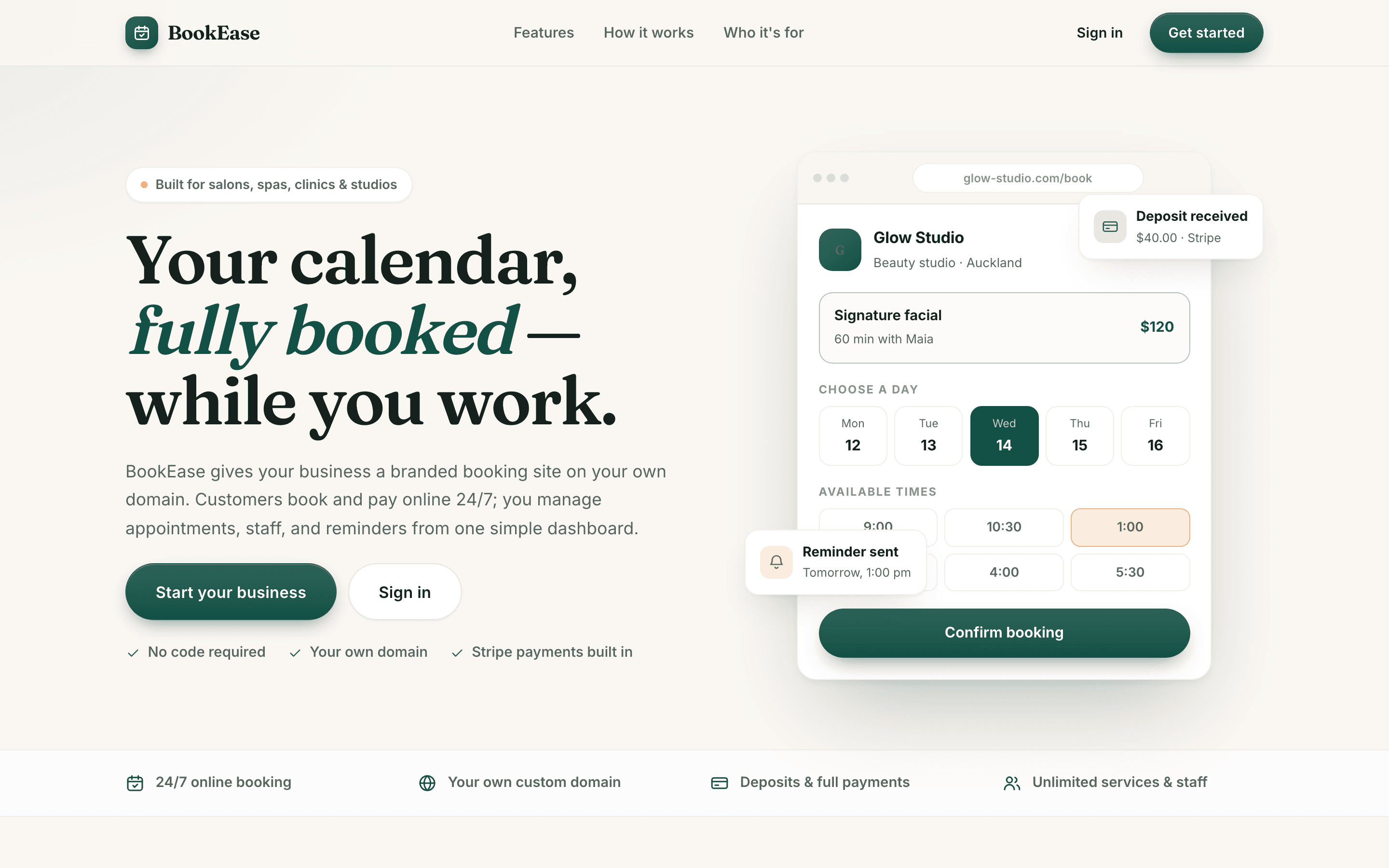
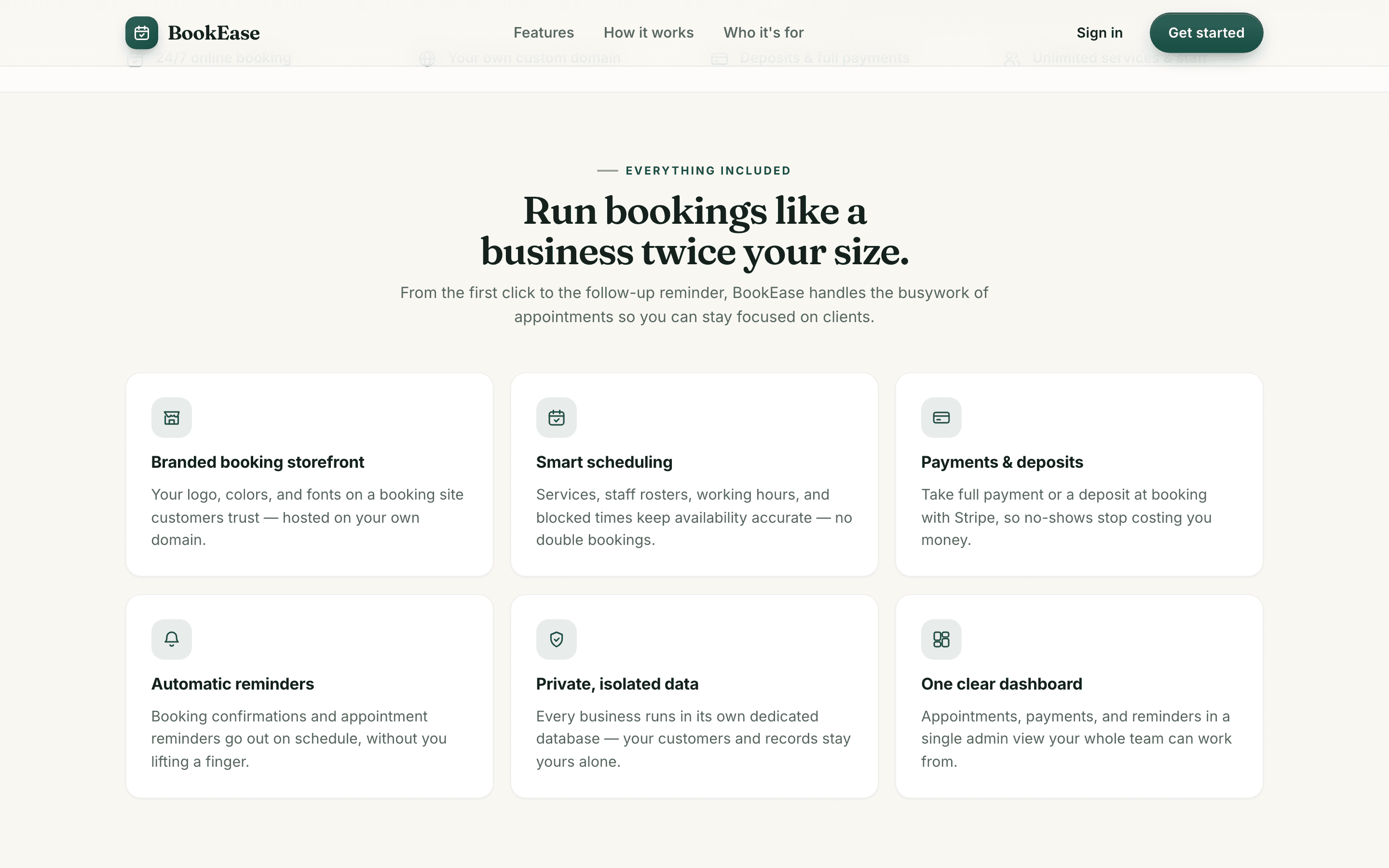
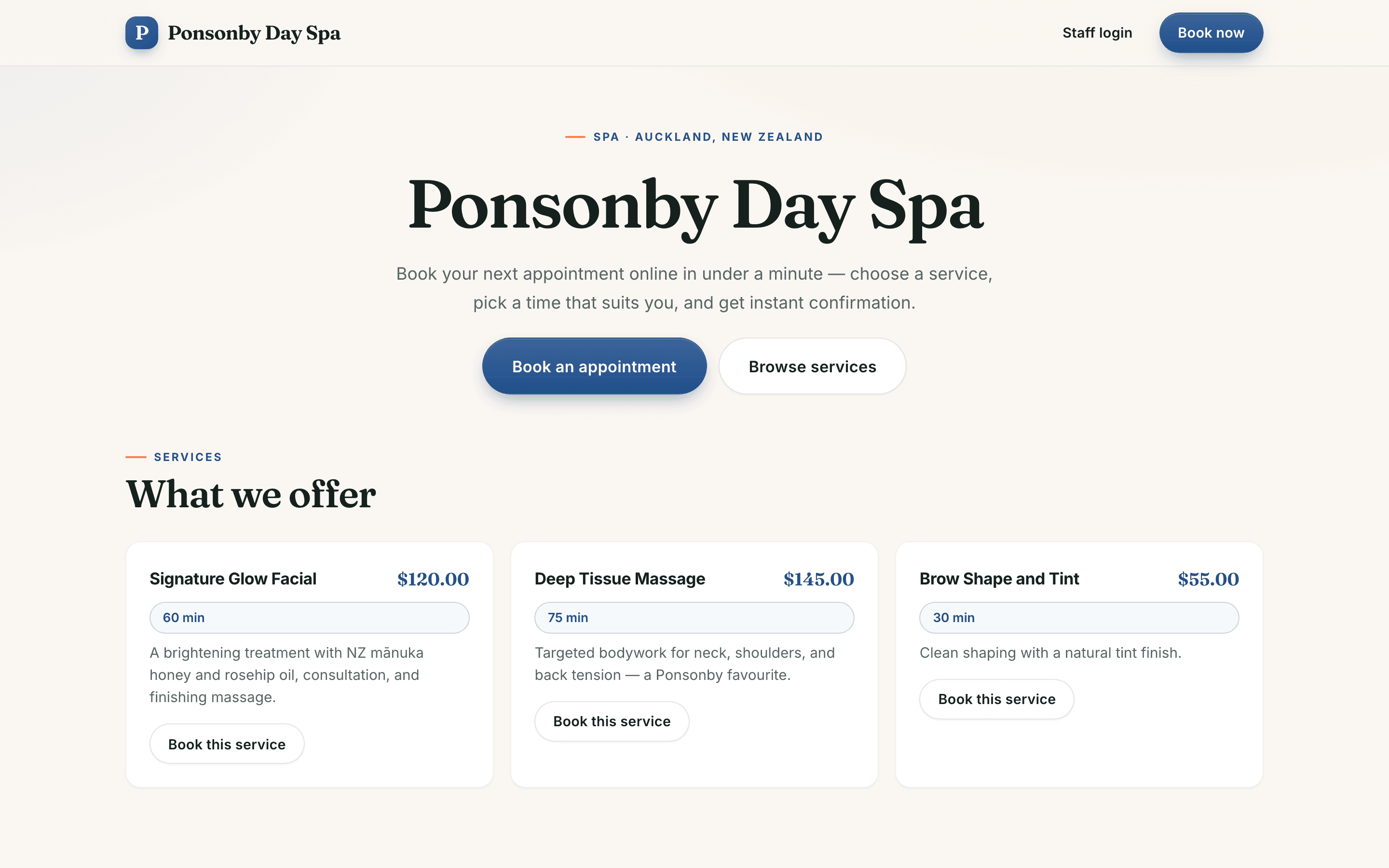
A launch-ready multi-tenant salon and spa booking platform built as one shared Fastify backend plus one shared Next.js web app, with one tenant database per business. It includes a control-plane for platform users, tenant registry, memberships, domains, audits, and migrations, while each tenant database owns services, staff, schedules, blocked times, customers, appointments, booking settings, payments, reminders, and tenant audit logs. The frontend runs in platform mode and tenant mode from a single codebase, using a host-aware BFF layer so tenant identity is resolved from the request host rather than browser-visible tenant ids. Public booking flows support service selection, optional staff selection, live availability, Stripe checkout, booking status polling, runtime tenant theming, and tenant admin surfaces under /admin. The platform also ships with branding controls, custom domain verification, demo reset and verify commands, worker processes for reminders and hold expiry, and localtest.me based launch testing. Ideal for salon chains, spa groups, appointment-based wellness brands, or founders building a white-label multi-tenant scheduling SaaS. Ships as a clean, documented codebase so you can rebrand, extend and deploy without starting from scratch.
Details
BookEase — Launch a Multi-Tenant Salon & Spa Booking SaaS Without the 12-Month Build
A launch-ready multi-tenant booking platform for salons, spas, and appointment-based wellness brands. One shared Fastify backend, one shared Next.js web app, and one tenant database per business — all wired together with control-plane management, custom domains, runtime tenant theming, and Stripe-powered checkout. Built for founders who want to ship a white-label booking SaaS in weeks instead of years.
If you have ever wanted to build a Calendly-meets-Mindbody competitor, a niche booking platform for a specific vertical, or a white-label scheduling SaaS for an industry you know — this MVP gives you the entire foundation.
Why you need this MVP
Multi-tenant SaaS is the hardest kind of software to build correctly. Tenant isolation, custom domains, theming, billing, control plane vs tenant plane, host-aware routing, migrations, and worker jobs — each one is weeks of work. Get any of them wrong and you have a security incident or a runaway bug.
This MVP solves all of them in one codebase. You get a production-grade multi-tenant architecture with database-per-tenant isolation (the gold standard for B2B SaaS), control-plane and tenant-plane separation, host-based tenant resolution, custom domain verification, runtime theming, worker processes for reminders and hold expiry, and demo tooling for local testing on localtest.me hosts.
You skip the 12-month architecture phase and go straight to product, pricing, and customer acquisition.
Key benefits
- Database-per-tenant isolation. The most secure and compliant multi-tenant pattern, already implemented.
- Control plane and tenant plane separation. Clean architecture for billing, ops, and tenant data.
- Custom domains. Verification flow built in. Tenants get their own branded URL.
- Runtime tenant theming. Each business sees their own colors, logos, and brand inside one Next.js app.
- Host-aware BFF routing. Tenant identity resolved from request host, not from browser-visible IDs.
- Stripe checkout. Payment intents and webhook-driven booking confirmation already wired.
- Worker processes. Reminders, hold expiry, and recurring jobs handled by a separate runtime.
- Demo tooling. Reset, verify, and start commands for deterministic local testing.
- HTTP-only cookie sessions. Secure session handling on day one.
How to make money with it
- Launch a niche booking SaaS. Salon, spa, massage, fitness, beauty, mobile services — pick a vertical and own it.
- Build a regional Mindbody competitor for a specific country or city.
- White-label it for franchises. Salon chains and spa groups need branded booking systems.
- Run it as a managed service. Charge per location or per appointment, take a percentage of bookings.
- Sell premium themes and templates to tenants who want differentiation.
- Layer in payment processing fees. Take a small percentage on every booking processed through Stripe.
- Offer enterprise tiers with custom domain, SSO, and advanced reporting.
- License the platform to industry associations or franchisors.
- Build adjacent verticals. The same architecture works for tutoring, coaching, photography, fitness, and any appointment-based business.
How you can use it
- Indie SaaS founders building a Calendly or Mindbody competitor for a niche
- Salon and spa franchise operators needing a white-label booking system
- Wellness brands offering classes, treatments, or appointments
- Tutoring and coaching platforms that need multi-tenant scheduling
- Photography and creative service marketplaces with appointment flows
- Fitness studios and personal trainers needing branded booking pages
- Mobile service businesses like cleaning, repair, or beauty
- Industry associations offering booking infrastructure to members
- Agencies building custom booking platforms for clients
How it boosts your productivity
You skip the most painful 12 months of any multi-tenant SaaS project: the architecture, the tenant isolation, the custom domains, and the billing plumbing. Every hard decision has been made and tested.
- Skip 6 to 12 months of architecture work. Database-per-tenant, control plane, and host routing already built.
- One Next.js codebase serves all tenants. Add a customer, point a domain, done.
- Stripe pre-configured. Payment intents and webhooks already wired.
- Workers ready. Reminders, hold expiry, and recurring jobs run in a separate process.
- Demo and test tooling. Local development uses
localtest.mefor realistic multi-tenant testing. - Type-safe contracts. Zod schemas mean fewer bugs in the highest-stakes flows.
- Playwright and Vitest configured. Test critical journeys without setting up infrastructure.
- Migration tooling. Add a column to all tenant databases with one command.
For a solo founder, this is the difference between shipping in 6 weeks and never shipping at all.
What is included
- Shared Next.js 16 web app serving platform marketing, owner onboarding, tenant storefronts, booking flows, and tenant admin from one codebase
- Shared Fastify 5 backend with control-plane and tenant APIs, host-based tenant resolution, and membership-aware RBAC
- Worker process for reminders, payment hold expiry, and recurring jobs
- Prisma control-plane and tenant schemas with separate generated clients
- Database-per-tenant orchestration with migration tooling
- Custom domain verification flow
- Runtime tenant theming
- Stripe checkout with payment intents and webhook-driven booking confirmation
- HTTP-only cookie sessions for secure auth
- Demo reset, verify, and start commands for deterministic local testing
localtest.mehost setup for realistic multi-tenant local development- Playwright end-to-end coverage and Vitest component tests
Tech stack at a glance
- Languages: TypeScript end to end
- Frontend: Next.js 16, React 19, App Router, BFF routes
- Backend: Fastify 5 (Node.js)
- Database: PostgreSQL with Prisma ORM (control plane + per-tenant schemas)
- Payments: Stripe (Payment Intents)
- Notifications: Twilio for SMS reminders
- Validation: Zod
- Testing: Playwright, Vitest
Ideal for founders building a multi-tenant booking SaaS, salon and spa platform, white-label scheduling product, wellness booking marketplace, or niche appointment SaaS for any vertical that needs tenant isolation, custom domains, and Stripe-powered bookings.
 Playwright
What’s included
- Seeded with multi-tenant architecture content, variants, reviews, stack metadata, and platform-hosted purchase fields.
- Built for Founders building multi-tenant booking SaaS products for appointment businesses.
- Provides tenant isolation, booking, payment, domain, admin, and worker foundations in one launch-ready MVP package.
- Full source code (Fastify + Next.js + Playwright + PostgreSQL + Prisma + React + Stripe + Twilio + TypeScript + Vitest + Zod)
- Purchase and delivery managed by MVP Hub
Reviews 3
The architecture is impressive and the launch docs are useful. I especially like the localtest.me path for host-aware testing and the fact that the frontend keeps tenant identity server-side through the BFF layer.
Strong full-product coverage for a salon and spa SaaS. Public booking, admin screens, platform admin, branding, domains, Stripe flows, reminders, and worker processes are all represented in one repo without feeling bolted together.
This is one of the few booking repos that takes multi-tenancy seriously. The control-plane versus tenant database split is clear, the host-aware routing model is coherent, and the demo reset tooling makes evaluation much easier.